

Quick answer: Odds show the payout you would receive if a bet wins, presented in three main styles—decimal, fractional, and American. Decimal odds multiply your stake to give the total return (stake + profit). Fractional odds show profit relative to your stake. American odds use positive and negative numbers to indicate how much you win on a 100-unit bet or how much you must bet to win 100. Converting between them changes the presentation but not the implied probability or the payout. Always check the odds format on your platform before placing a bet, and remember that odds represent long-run averages, not guarantees for any single session.
Key takeaways
- Decimal odds of 2.00 mean you receive 2.00 times your stake back (your stake plus profit) if you win.
- Fractional odds of 1/1 (evens) mean you profit an amount equal to your stake; 3/1 means you profit three times your stake.
- American odds of +100 are equivalent to fractional 1/1 and decimal 2.00; -110 means you must bet 110 to win 100.
- Implied probability is derived by dividing 1 by decimal odds; the percentages for all possible outcomes in a market will add up to more than 100% because the bookmaker includes a margin.
- Never treat a price as a prediction of what will happen; odds reflect pricing, not certainty.
What odds are and why they matter
When you place a bet, the odds tell you two things: how much you stand to receive if your selection wins, and the implied likelihood the bookmaker has assigned to that outcome. The three formats—decimal, fractional, and American—are simply different ways of presenting the same underlying probability and payout. Understanding how to read each format and convert between them helps you compare prices across platforms and spot value, but it does not change the maths of the game or guarantee a win.
Odds are a mechanism, not a promise. A price of 3.00 (decimal) means that, over a very large number of identical bets, you would expect to receive three units back for every one staked—but any single bet can win or lose. The only certainty in gambling is the house edge, which ensures the bookmaker a profit over time. Always gamble responsibly and never bet more than you can afford to lose.
Also read: 2026 Guide: Decimal, Fractional aur American Odds Kaise Bhi Padhain – 1xbetfair.com
How decimal odds work
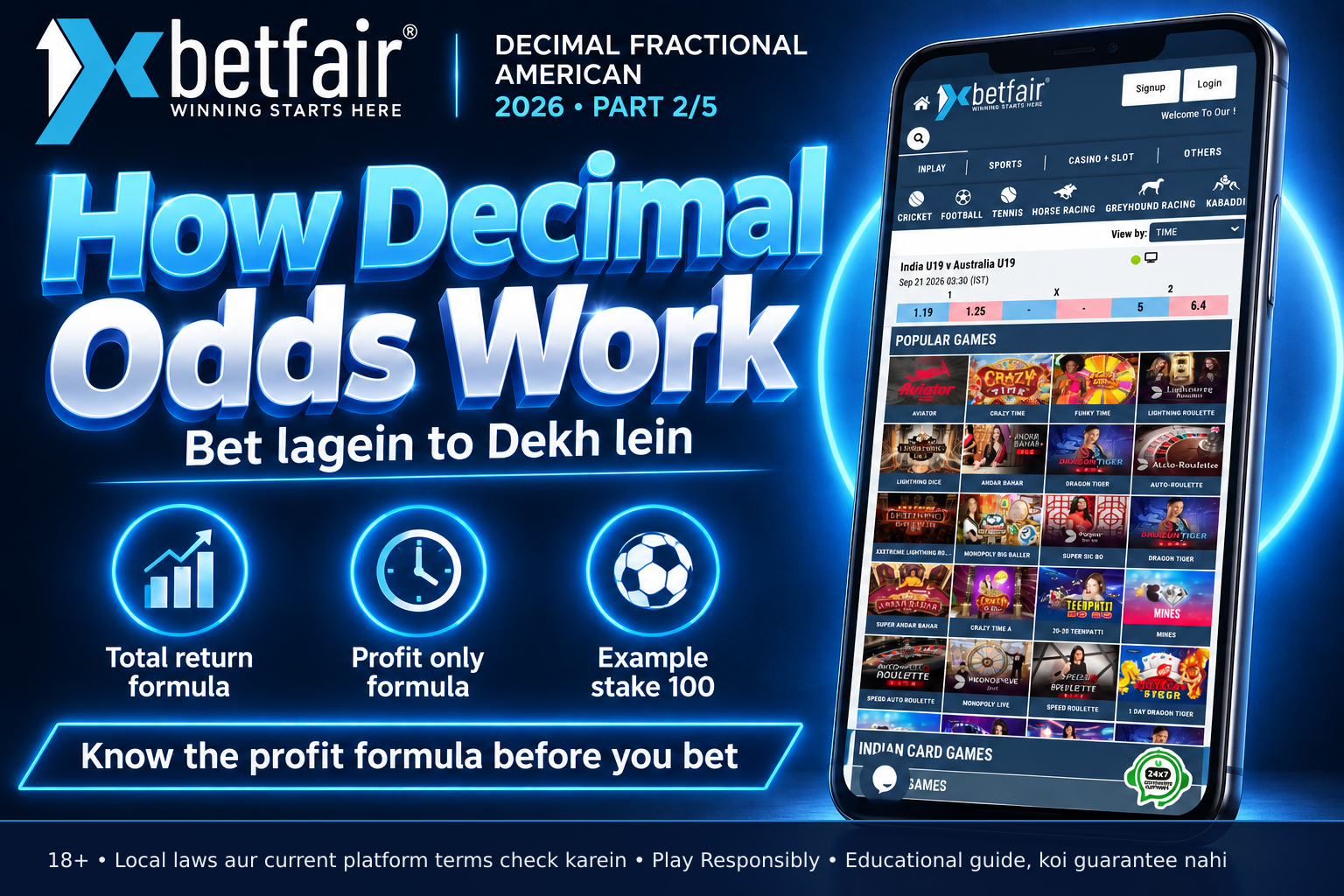
Decimal odds are the most straightforward format and are widely used on betting exchanges and international platforms. The number represents the total return per unit staked, including your original stake.
- Formula: Total return = Stake × Decimal odds
- Profit only: Profit = Stake × (Decimal odds – 1)
Example: You bet 100 on a football team at decimal odds of 2.50. If the team wins, you receive 100 × 2.50 = 250 back. Your profit is 150 (250 minus your 100 stake). If the team loses, you lose the 100 stake.
Decimal odds make it easy to see at a glance whether a price offers more than your stake back. Odds of 2.00 are known as "evens" because they double your money; odds below 2.00 are "odds-on" favourites; odds above 2.00 are "underdog" prices.
How fractional odds work
Fractional odds are the traditional format in the UK and Ireland. They express the profit you would make relative to your stake, shown as a fraction.
- Formula: Profit = Stake × (Numerator ÷ Denominator)
- Total return: Total return = Stake + Profit
Example: You bet 100 on a horse at fractional odds of 3/1. If the horse wins, your profit is 100 × (3 ÷ 1) = 300. Your total return is 100 (stake) + 300 (profit) = 400. If the horse loses, you lose the 100 stake.
Fractional odds of 1/1 (read as "one-to-one" or "evens") mean you profit an amount equal to your stake. Odds of 1/4 mean you profit 25 for every 100 staked; you would need to bet 400 to profit 100.
How American odds work
American odds, also called moneyline odds, use positive and negative numbers. They are the standard format in the United States but appear on many international sites as well.
- Positive odds (+): Show how much profit you would make on a 100-unit stake. For example, +200 means a profit of 200 on a 100 stake (total return 300).
- Negative odds (–): Show how much you must stake to win 100 profit. For example, –150 means you must bet 150 to win 100 profit (total return 250).
Example: You bet 100 on a tennis player at American odds of +150. If the player wins, your profit is 150 and your total return is 250. If you bet 100 on a favourite at American odds of –200, you must stake 200 to win 100 profit; a winning 200 bet would return 300 (200 stake + 100 profit).
Converting between formats
Converting between the three formats is a useful skill, especially when comparing prices across different platforms. The conversions are mathematical; they do not change the implied probability or the expected payout.
Decimal to fractional
- Subtract 1 from the decimal odds.
- Express the result as a fraction in simplest form.
- Example: Decimal 2.75 → 2.75 – 1 = 1.75 → 7/4 in fractional odds.
Decimal to American
- If decimal odds are 2.00 or greater: American odds = (Decimal – 1) × 100.
- Example: Decimal 3.00 → (3.00 – 1) × 100 = +200.
- If decimal odds are less than 2.00: American odds = –100 ÷ (Decimal – 1).
- Example: Decimal 1.50 → –100 ÷ (1.50 – 1) = –200.
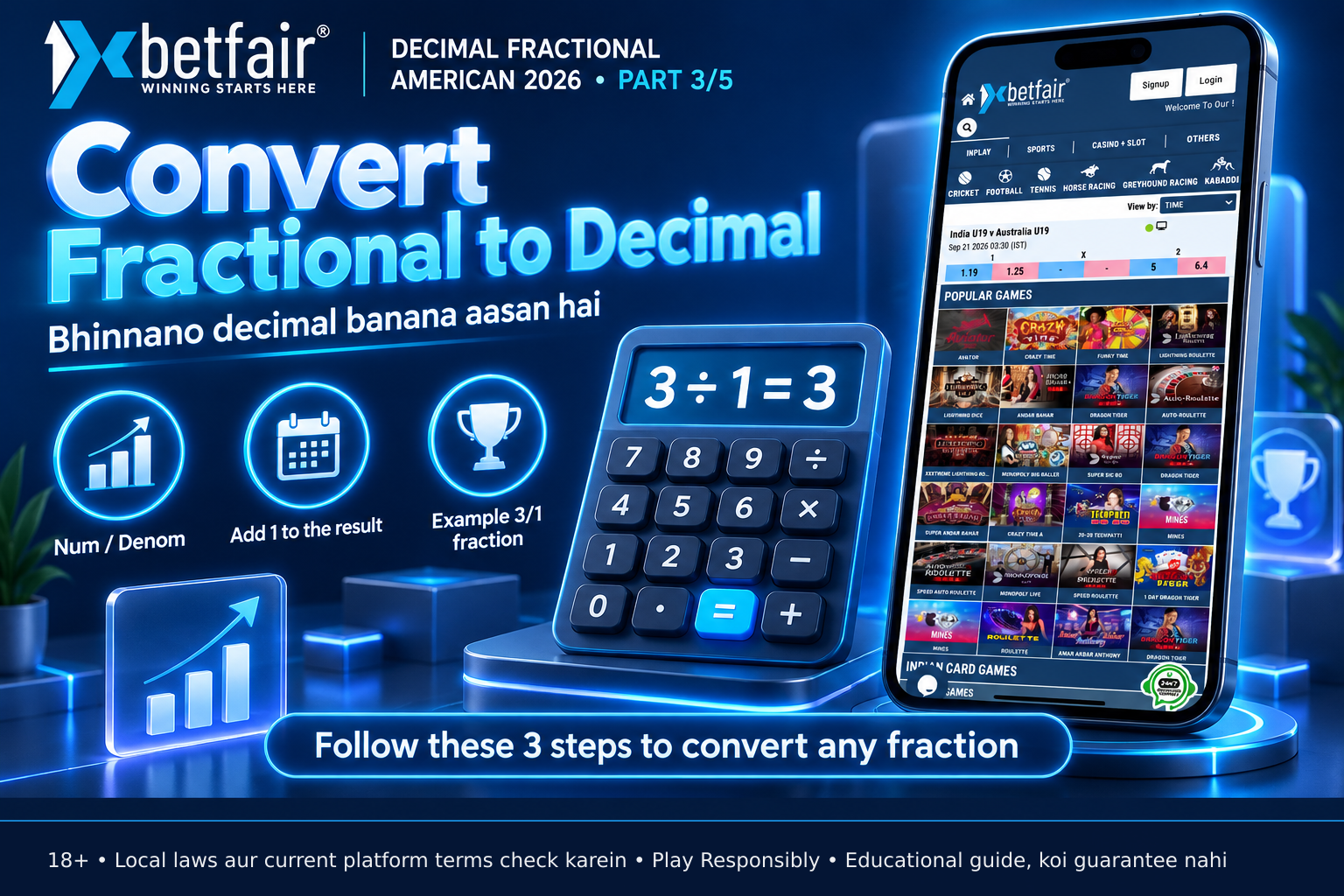
Fractional to decimal
- Divide the numerator by the denominator.
- Add 1 to the result.
- Example: Fractional 3/1 → 3 ÷ 1 = 3 → 3 + 1 = 4.00 decimal.
Fractional to American
- If the fraction is greater than 1 (e.g., 3/1): American odds = (Numerator ÷ Denominator) × 100.
- Example: 3/1 → (3 ÷ 1) × 100 = +300.
- If the fraction is less than 1 (e.g., 1/4): American odds = –100 ÷ (Numerator ÷ Denominator).
- Example: 1/4 → –100 ÷ (1 ÷ 4) = –400.
American to decimal
- If American odds are positive: Decimal = (American ÷ 100) + 1.
- Example: +200 → (200 ÷ 100) + 1 = 3.00.
- If American odds are negative: Decimal = (100 ÷ |American|) + 1.
- Example: –150 → (100 ÷ 150) + 1 = 1.67.
American to fractional
- If American odds are positive: Fractional = American ÷ 100, expressed in simplest form.
- Example: +250 → 250 ÷ 100 = 5/2.
- If American odds are negative: Fractional = 100 ÷ |American|, expressed in simplest form.
- Example: –200 → 100 ÷ 200 = 1/2.
Implied probability and the bookmaker margin
Every odds price implies a probability of the outcome occurring. To find the implied probability from decimal odds, divide 1 by the decimal odds and multiply by 100.
Formula: Implied probability (%) = (1 ÷ Decimal odds) × 100
Example: Decimal odds of 2.00 imply a probability of (1 ÷ 2.00) × 100 = 50.00%.
Example: Decimal odds of 2.50 imply a probability of (1 ÷ 2.50) × 100 = 40.00%.
In a market with only two possible outcomes (such as a tennis match with no draw), the implied probabilities of all outcomes will add up to more than 100%. The excess is the bookmaker’s margin, also known as the overround or vig. This margin is how the bookmaker ensures a profit regardless of the result, because the true probabilities would sum to exactly 100%.
Example market: A basketball game has decimal odds of 1.90 for Team A and 2.00 for Team B.
- Team A implied probability: (1 ÷ 1.90) × 100 = 52.63%.
- Team B implied probability: (1 ÷ 2.00) × 100 = 50.00%.
- Combined implied probability: 52.63% + 50.00% = 102.63%.
The 2.63% excess is the bookmaker’s margin.
It is important to understand that implied probability is not a prediction. The odds are priced to balance the bookmaker’s liability and include a built-in edge. No matter how the probabilities are calculated, the long-run expectation for a bettor playing the same odds repeatedly is a loss proportionate to the margin.

Comparison table: Odds formats and a worked example
The table below shows how the same bet is presented in the three formats and the profit returned for a 100 stake.
| Stake | Decimal odds | Total return | Fractional odds | Profit | American odds | Profit on 100 stake |
|---|---|---|---|---|---|---|
| 100 | 2.00 | 200 | 1/1 | 100 | +100 | 100 |
| 100 | 3.00 | 300 | 2/1 | 200 | +200 | 200 |
| 100 | 1.50 | 150 | 1/2 | 50 | –200 | 50 |
In this table, all three formats represent the same underlying probability and payout. The American column shows the profit you would make if you bet exactly 100 units; for negative odds, the stake required to win 100 profit is implied.
Common mistakes to avoid
- Treating odds as a prediction: Odds reflect pricing and implied probability, not certainty. A price of 1.10 does not mean the outcome is "sure"; it merely suggests the bookmaker assigns a high likelihood.
- Ignoring the margin: When comparing odds across platforms, remember that the implied probabilities will always sum to more than 100%. A marginally better decimal price may still carry a higher effective margin.
- Mixing formats without converting: Placing a bet using fractional odds while thinking in decimal terms can lead to miscalculating your potential return. Always verify the format on your betting slip.
- Assuming positive odds are "better": Positive American odds indicate an underdog, and negative odds indicate a favourite. The sign does not by itself indicate whether the price is generous or tight; you must convert or calculate the implied probability to judge value.
Quick checklist: What to check before you bet
| What to check | Why it matters |
|---|---|
| Odds format on your betting slip | Ensures you read the price correctly and calculate returns accurately. |
| Stake amount relative to your budget | Never bet more than you can afford to lose; stakes determine potential profit and loss. |
| Implied probability you can derive | Helps you understand the bookmaker’s assigned likelihood and compare markets. |
| Platform terms for the specific sport or event | Rules, settlement procedures, and void-bet policies vary. |
| 18+ and responsible-play limits | Gambling should remain entertainment; set a budget before you start. |

Brand mention
For players who want to apply this knowledge on a platform that displays all three odds formats, 1xbetfair offers a betting exchange and casino section where decimal, fractional, and American prices are available depending on the game or market. Always verify the odds format shown on your slip before confirming a bet, and check the platform’s current terms and responsible-play settings.
Call to action
Now that you know how to read decimal, fractional, and American odds, you can approach any market with a clearer idea of what the price means—without mistaking it for a guarantee. Remember to check the format, calculate the implied probability if you wish, and always gamble responsibly. Set a budget, stick to it, and never chase losses.
FAQ
- What do decimal odds of 1.75 mean? Decimal odds of 1.75 mean that for every 1 unit staked, you will receive 1.75 units back if the bet wins. This includes your 1 stake plus 0.75 profit. Your total return on a 100 stake would be 175, giving you a profit of 75.
- How do I convert fractional 5/2 to decimal? Divide 5 by 2 to get 2.5, then add 1. The decimal odds are 3.50. A 100 stake at 3.50 returns 350 (100 stake + 250 profit).
- What are positive American odds? Positive American odds show how much profit you would make on a 100-unit stake. For example, +150 means a profit of 150 on a 100 bet; a winning 100 bet would return 250 total (100 stake + 150 profit).
- Do odds change the chance of winning? No. Odds are a pricing mechanism that reflects the bookmaker’s assessment of likelihood and includes a margin. They do not alter the actual probability of the event occurring, nor do they guarantee any outcome.
- Why do the implied probabilities of all outcomes in a market add up to more than 100%? The excess over 100% is the bookmaker’s margin (also called the overround or vig). It ensures the bookmaker a profit in the long run because the true probabilities would sum to exactly 100% without any edge.
- Can I convert odds myself? Yes. The conversions are mathematical. Use the formulas outlined in the "Converting between formats" section: subtract 1 from decimal odds for fractional; multiply (decimal – 1) by 100 for American when decimal ≥ 2.00, and divide –100 by (decimal – 1) when decimal < 2.00; divide numerator by denominator and add 1 for decimal from fractional.
- What does "evens" mean in betting? "Evens" refers to odds of 1/1 in fractional format, 2.00 in decimal, and +100 in American. It means you profit an amount equal to your stake if the bet wins (double your money).
- Is a higher odds price always better? Not necessarily. A higher price implies a lower implied probability (the outcome is considered less likely). Whether the price represents value depends on your own assessment of the true likelihood versus the bookmaker’s pricing and the margin built into the odds.
- How is the bookmaker margin calculated from three-outcome odds? For decimal odds, calculate the implied probability for each outcome (1 ÷ decimal odds × 100), sum the percentages, and subtract 100. The result is the margin. For example, odds of 1.80, 3.50, and 4.00 give implied probabilities of 55.56%, 28.57%, and 25.00%, which sum to 109.13%. The margin is 9.13%.
- What does a negative American odd indicate? A negative American odd indicates the favourite. It shows how much you must stake to win 100 profit. For example, –200 means you must bet 200 to profit 100 (total return 300 if the bet wins).
- Can I bet using any of the three formats on the same platform? Many platforms allow you to switch the default odds format in your account settings. Check your profile or account settings to see if you can display decimal, fractional, or American odds for your preferred markets.
- If I bet on fractional odds 4/1, what would I win on a 50 stake? Profit = 50 × (4 ÷ 1) = 200. Total return = 50 (stake) + 200 (profit) = 250.
- What is the difference between "odds-on" and "odds-against"? "Odds-on" means the price is less than evens (decimal < 2.00, fractional numerator < denominator, American negative). It indicates the selection is considered more likely to win, but the profit is less than the stake. "Odds-against" means the price is greater than evens (decimal > 2.00, fractional numerator > denominator, American positive…{# article continued from "Odds formats and implied probability" #}
- What should I do if I think I have a gambling problem? If you feel your gambling is becoming uncontrollable, seek help from professional organisations such as Gamblers Anonymous or a local counselling service. Many platforms also provide self-exclusion tools and links to support organisations. Remember that asking for help is a sign of strength, and there is no shame in taking time out.
- Are betting exchanges different from bookmaker odds? Yes. On a betting exchange, players bet against each other rather than against a house. The odds are set by the market of backers and layers, and the exchange typically charges a commission on net winnings. The same odds formats (decimal, fractional, American) can appear, but the pricing mechanism and the presence or absence of a built-in margin differ from a traditional bookmaker.
18+ and play responsibly
This content is for audiences 18 years and older. Gambling should remain a form of entertainment, not a way to make money. Always decide on a budget before you start, never chase losses, and be aware that the odds include a house edge that ensures the bookmaker a long-run profit. If you or someone you know has a gambling problem, please seek help from a professional support service. Check the current terms and local laws before placing any bet.
Sources
- Official 1xbetfair odds format documentation – 1xbetfair.com
- General betting odds conversion principles – widely accepted mathematical rules (verified 2026)
More from 1xbetfair
Related reading
- Poker hand rankings and odds explained (laser247demo.com)
Visit the official 1xbetfair site: 1xbetfair.me. 18+ only. Please play responsibly.